CORINTH CIVITAS
Corinth has been selected by Roberto Amati in relation to the real history of european integration, then enlisted in the CITY OR CIVITAS category, accompanied by own fact SHEET useful to the comprehension, completed of historical MAPS AND IMAGES or with a direct linking to the related Blog contents dedicated to the the aeternitas and the future of Europe.
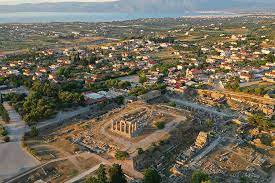
Corinth is one of the most ancient cities of the history of European integration, signed in great part by Christianity. It was founded thousands years ago by Greeks people, on the homonimous gulf in the Ionian sea developing its commercial spirit, under the protection of the god Apollo. The city-state (πόλις) of Corinth was invaded by Dorian people around 1,000 B.C. and became famous still today for its specific architectural style, a centre known for democracy, arts, education, philosophy and trading, such important that highly influenced the European continent, particularly in ancient Rome, still today regarded as the cradle of Western civilization and the birthplace of Christianity.
Corinth always maintained its independence and was one of the leading centres of trading and prosperity in the Peloponnese, developed a significant naval power and was member of the Delphi League against the Persian invasion in V century B.C., allied to its eternal rival city of Sparta. But after the Peloponnesian War winning, Corinth couldn't avoid the submission to Macedonian kingdom and successively the conquer by Romans in the II century B.C., so that together with all Greece the Civitas Corinth became part of the Roman Respublica.
Within the reform of Augustus (see Roman Empire) Corinth was elevated capital of the Achaja province, once being destroyed and rebuilt in 44 B.C. as Colony for Greeks and Italics veterans. Julius Caesar decided the opening of the Corinth canal to the sea, still existing, to empower naval tradings to the Brindisi and Italian's ports, then Corinth was connected to the rest of Balcanic peninsula by the Graeca way, reaching the other ancient and christian civitas of Thessaloniki and Athens ending in Apulum in Dacia province, and the Dalmatica way, starting from Aquileia and running all along the Adriatic sea coasts passing through the cities of Rijeka, Solin, Durres, Athens to end in Patras.
With the reform of Constantine I (see Christian Empire), Corinth became the capital of the Achaja Diocesis cause its ancient christian community had been founded by Saint Paul. After the sacks of Visigoths and Slavs, between V and VI centuries A.D., Corinth was confirmed capital of the bizantine Hellas theme and followed the political events and resurrection of the Byzantine Empire, as the Crusader's sack of 1204 A.D. that captured Corinth to the Catholics Church and joined to the Principade of Achaja until 1458 A.D., when it was conquered by Turks. At the end of the Greek War of Independence, in 1830 A.D. Corinth became the purposed capital of the Kingdom of Greece under the rule of the Oldenburg dinasty and remained until the terific heartquakes in 1858 A.D. and 1928 A.D. that completely destroyed the city.
Nowadays, are visitable the ruins of the ancient Corinth and the Apollo Temple, of the Acrocorinto castle and the Saint Paul cathedral, the most ancient church of Corinth built in II century A.D.. City of Corinth is located in the center-north of Greece within the Macedonia region, whose patron is Saint Dionysius one of the first bishop of the city.
If you want keeping in touch with the author send an email. Learn more on the book and next presentations on website.